


Habanero
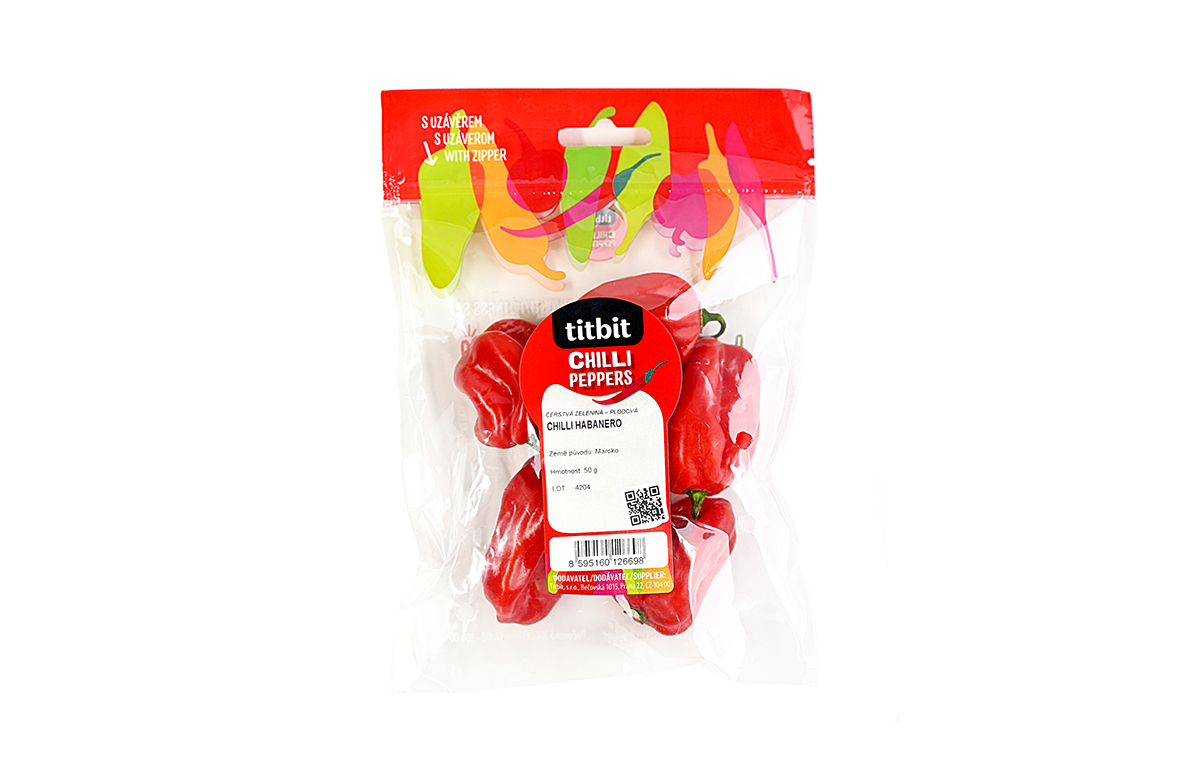


Product line


Packaging
- 50 g bag
Availability by month
- 1
- 2
- 3
- 4
- 5
- 6
- 7
- 8
- 9
- 10
- 11
- 12
buy in e-shops

cooperation
Are you interested in our product line?
Would you like to know our prices, try some samples, or take a tour of our facility?
We supply restaurants and hotels
Orders 24 hours a day
- Delivery to most cities in the Czech Republic—call +420 608 217 567
This decorative pepper grows to a size of 2–6 cm and is strongly hot. It was originally grown in Cuba, where it got its name (derived from La Habana) and from there it spread to Yucatan, Costa Rica, Belize and some areas of the USA. Sometimes its name is misspelled as habañero. Unripe habaneros are green, but change their color to orange and red as they ripen. Most habanero peppers reach 200,000–300,000 Scoville hotness units (SHU). For comparison, cayenne pepper has 30,000–50,000 SHU and pepper spray has around 5,300,000 SHU.
Peppers are very popular for the preparation of various cold and hot sauces, pastes and seasonings. Sambal paste made from chili peppers, garlic, onion, shallots, salt, vinegar and sugar is known – it is often used in Indonesia, Malaysia, Sri Lanka and South Africa. It is used as a seasoning, dip or dressing.
Another popular paste is the so-called Harissa. Harissa, which is a mixture of chili peppers and garlic, typical of North Africa, especially Morocco, Tunisia and Algeria. Occasionally, other ingredients are also added – coriander, olive oil, tomato apples, cumin and others. It is most often used to flavor dishes.
A combination of chili peppers and coriander is common, which perfectly complements and “matches” their taste and expressiveness.
Chili peppers should never be consumed whole – they could even cause serious damage to the digestive tract!
Red types of chili peppers are rich in vitamin C and carotene, some B vitamins, magnesium and iron.
Yellow and green peppers (unripe) have a significantly lower vitamin content. Chili peppers are native to the American continent, especially South America, where their cultivation and use is documented as early as 7,500 BC. After their discovery by Spanish colonizers, they very quickly spread to other tropical and subtropical parts of the world, so in addition to South and Central America, we can also find them in India, China, Japan, Vietnam and Africa. They are also widely used in the Balkans. They are used as a dish, spice and medicine. Their healing effects were described as early as the 15th century during the expeditions of Christopher Columbus.

