


Cassava
⏱️ Reading time: 2 min
Cassava is a tropical crop native to South America. Today, it is grown most extensively in Nigeria and Brazil. It is estimated to be the primary source of carbohydrates for up to 500 million people worldwide. Up to 165 million metric tons of tubers are harvested annually. One advantage is that it can be grown without major problems even in areas with low rainfall and where the soil is not very nutrient-rich.
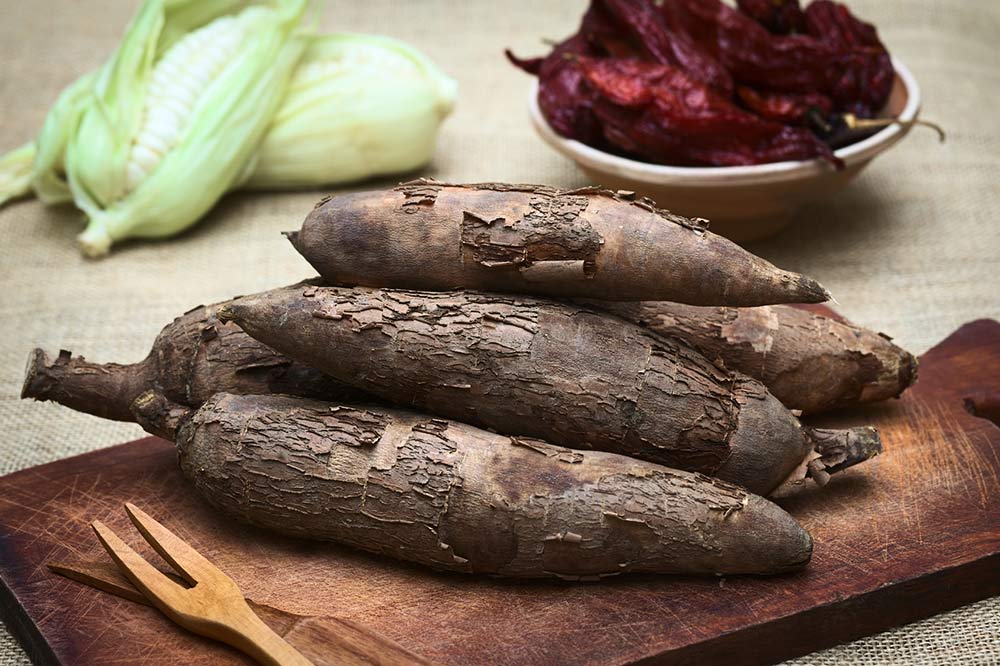
What does cassava actually look like?
Cassava grows either as a shrub or as a herbaceous plant reaching a height of 1 to 5 m. The flowers are usually light yellow or red, and the leaves are long and petiolate. The fruit is a seed capsule about 1.5 cm long. The cassava tubers are eaten; they are brown on the outside and white on the inside.
Gluten-Free Cassava and Other Reasons to Eat It
Cassava contains almost no fat and is naturally gluten-free. It is a valuable source of energy, especially in developing countries, as it contains nearly twice as many calories as potatoes. It also contains vitamins, primarily those of the B complex. Additionally, it contains vitamin K, which is important for healthy bones and teeth and is also used to treat Alzheimer’s disease by limiting damage to neurons in the brain. Minerals present include copper, zinc, iron, and potassium. Last but not least, it also helps lower blood pressure and blood cholesterol levels.
How can I tell if cassava is of good quality, and how should I store it?
When buying cassava, make sure it isn’t bruised. If the brown skin is damaged, it will be covered with a whitish, waxy layer. Cassava is stored similarly to potatoes. If possible, store it in a dry cellar, where it will keep for up to three months. Scrape off the skin before preparing it.
Cooking with Cassava
It is most commonly prepared in a similar way to potatoes. It can also be grated and used as a flour to make flatbreads, or used as a thickener. In some parts of Africa and Asia, cassava leaves are also used; you can prepare them much like spinach.
Cassava is also fermented and later distilled into liquor, or used to make beer or vinegar. Older varieties of cassava had to be boiled for a long time to remove the hydrogen cyanide, which today’s cultivars no longer contain.