


Healthy Snacking
⏱️ Reading time: 4 min
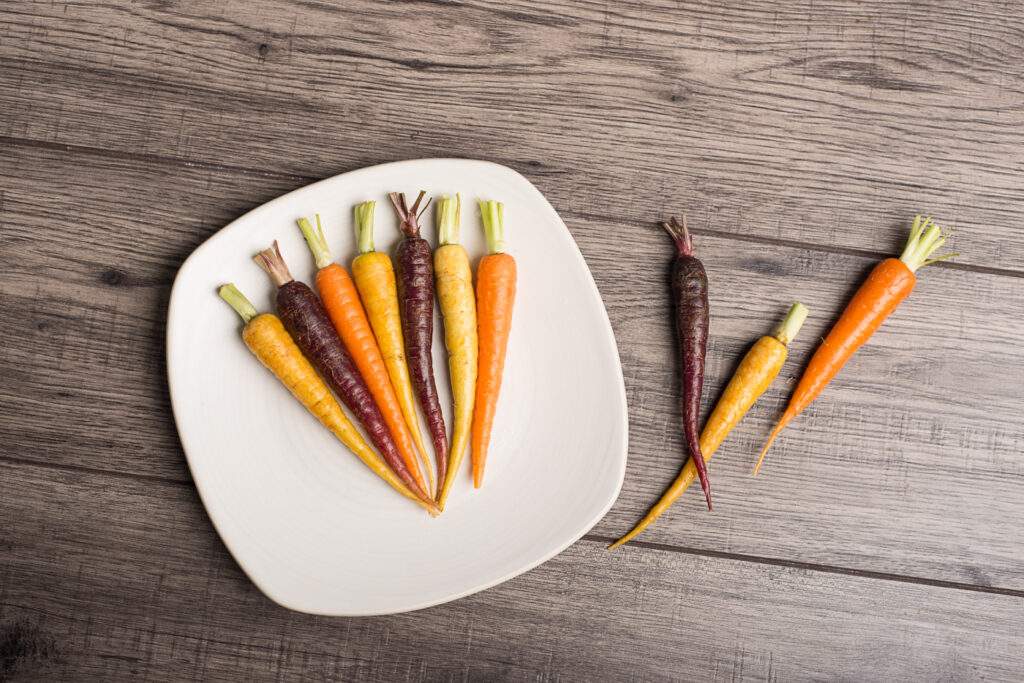
Grass is green, the sky is blue, and carrots are orange. Or are they? What’s the story with the color of carrots, anyway? Why do we most often see them on store shelves with an orange “coat,” and what causes some varieties to turn purple, for example?
A Little Bit of Carrot History
The very first varieties of carrots were purple, yellow, or white. Their origins date back to 2000 B.C.—purple, carrot-like plants are depicted in Egyptian temples. The ancient Greeks and Romans knew it more as a medicinal plant than as a vegetable. Cultivated carrots appeared in Europe in the 12th century. The seeds came from the regions of Afghanistan, Pakistan, and northern Iraq.
According to historical sources—which, however, may not be 100% accurate—the Dutch are credited with giving this root vegetable, perhaps the most widespread of its kind, its orange color. Local growers reportedly bred it in honor of King William of Orange. Orange is, after all, the traditional Dutch royal color. Or perhaps orange carrots simply thrived better, and growers simply came to prefer them.
However, orange carrots apparently existed in nature long before William of Orange. As early as 512 AD, illustrations of cultivated carrots with a distinctive orange color appeared in Julianus Anicius’s chronicle, the *Codex*. Nevertheless, it remains true that different regions have different customs—and different carrot colors as well. In China and Japan, where carrots are a staple of most meals, the traditional colors remain yellow and red to this day. In markets across the Middle East and Asia Minor, on the other hand, purple carrots are a common sight.
Healthy Snacking
Carrots are valued mainly for their beta-carotene content, a provitamin A from which our bodies produce vitamin A. We all remember well from our grandmothers that if we want healthy eyes, we have to eat carrots. But they’re also a rich source of vitamins B, C, and E, as well as easily absorbable calcium, pectin, and fiber.
Yellow carrots contain xanthophylls, pigments similar to carotenoids. They improve vision—they slow the degeneration of the macula in the eye and even reduce the risk of certain types of cancer.
Red carrots contain lycopene, a pigment found in tomatoes and watermelon. It helps prevent heart disease and certain types of cancer.
Purple carrots owe their color—much like blueberries—to anthocyanins, which are powerful antioxidants. They prevent the buildup of plaque in blood vessels and thus help prevent heart attacks.
What to Do with It in the Kitchen
In our kitchen, carrots are an indispensable ingredient in soups, sauces, and frozen vegetable mixes. The English make carrot pudding, the French candy them, and a good carrot cake is a treat enjoyed virtually everywhere in the world. So they can be boiled, baked, fried, glazed, or braised… “Try to use carrots according to your imagination and don’t be afraid to experiment. You can prepare various types of creams, purées, and stuffings, and use them as a sweet addition to desserts,” advises Jan Horký, captain of the AKC ČR National Team.
Carrots are one of the few vegetables that are more nutritious when cooked. This is because their thick cell walls prevent the body from absorbing more than 25% of the available beta-carotene from raw carrots, whereas our bodies can absorb up to 50% from cooked or steamed carrots. Serve them with a little oil, which will further enhance absorption. Chinese cuisine, which lightly sautés fresh vegetables, increases the nutritional value of carrots in particular. Gentle cooking also preserves other antioxidants. Carrot juice is another good source of beta-carotene.
When it comes to preparation, it’s entirely up to you whether you peel the carrots or not. Peeled carrots are generally tastier and, of course, cleaner, but you can also thoroughly clean them with a sponge or a plastic scrubber and use them whole. There are a hundred ways to cut them, so everyone can choose according to their own taste. “Try boiling baby carrots in water with baking powder. That way, they’ll stay a beautiful orange color and will be easy to peel even without a peeler,” Horký reveals.
Colorful carrots are a real feast for the eyes. Colorful carrot slices will brighten up your plates, while diced carrots will add a pop of color to your salads. After cooking, the purple color of the root vegetable fades, but if you want to preserve it, quickly sauté the carrot pieces over high heat in a little oil.
Purchasing and Storage
During the season, you can buy fresh carrots with their green tops still attached. However, you should remove the tops immediately so they don’t unnecessarily deplete the carrots of nutrients. The tops are also edible, but be careful—they may taste bitter. “Choose carrots primarily based on their appearance and go for the firmer ones. Make sure they aren’t shriveled, cracked, or rotten,” advises Vojtěch Havránek from Titbit.